If you’re serious about growing your business, client acquisition can’t be a guessing game. Too many business owners chase leads without a plan, wasting time and money on "random acts of marketing" that don't convert. They try a little social media here, buy a few ads there, and hope something sticks. But hope is not a strategy. To get consistent results, your efforts must align with a clear sales funnel and defined client acquisition strategies. You need to move away from chasing the latest "growth hacks" and start building a repeatable system.
Key Takeaways:
- A client acquisition strategy is essential for aligning your daily tactics with your long-term business goals.
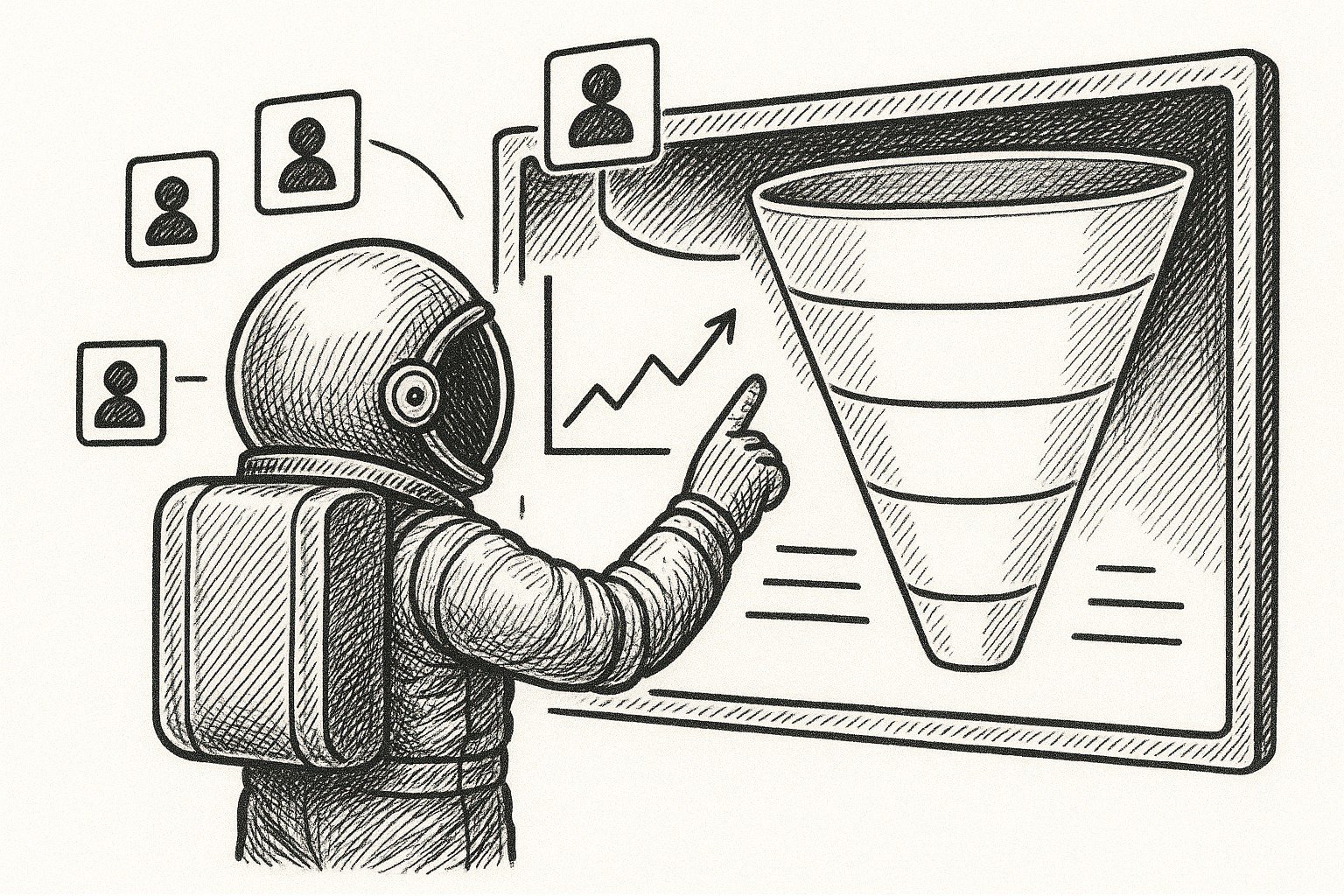
- The four funnel stages are Awareness (brand intro), Consideration (compare options), Conversion (buy), and Retention (stay loyal).
- Ideal Customer Profiles (ICPs) must be validated by real-world data and interviews, not just internal assumptions.
- Customer Acquisition Cost (CAC) is simply the total amount you spend to get a customer divided by the number of customers you actually get.
- LTV:CAC Ratio should ideally be 3:1; if it is 1:1, you are breaking even and likely stalling growth.
- Organic strategies (SEO, Content) build long-term trust and lower costs over time, while paid strategies (Ads) offer speed and immediate data.
- Retention is critical: It is 5x to 25x cheaper to keep a customer than to acquire a new one.
- Automation tools are necessary to prevent leads from slipping through the cracks of a busy sales team.
The Necessity of a Client Acquisition System
A business without a client acquisition system is just hoping for the best. Growth does not happen by luck; it happens by design. A clear client acquisition strategy guides your decisions, dictates your budget, and maintains forward momentum even when the market shifts.
Why "Random Acts of Marketing" Fail
Many businesses suffer from what we call "shiny object syndrome." They hear that TikTok is the new big thing, so they immediately pivot to video. Then they hear email marketing is dead, so they stop their newsletter, then bring it back the following week. This lack of consistency kills growth.
Without a cohesive plan that aligns Vision, Strategy, and Tactics (the VSTA framework), you end up with:
- High Churn: Clients leave as quickly as they arrive because the sales promise didn't match the service reality.
- Unpredictable Revenue: You don't know where your next lead is coming from, making it impossible to hire or invest confidently.
- Wasted Budget: You spend money on ads that target the wrong people or push products they aren't ready to buy.
- Misaligned Teams: Sales blames marketing for "bad leads," and marketing blames sales for "not closing."
A strategic system solves this. It creates a predictable path from "stranger" to "loyal client."
Funnel Mapping’s Role in Client Acquisition Strategies
A complete acquisition plan matches each step of the sales funnel. You cannot treat a person hearing about you for the first time the same way you treat someone ready to sign a contract.
- Awareness: The prospect realizes they have a problem. Your goal here is simply to be seen.
- Consideration: They are researching solutions and comparing you to competitors. You win here with authority and proof.
- Conversion: They are ready to buy. You need clear offers and a frictionless path to payment.
- Retention: You keep them coming back. This is where profit is actually made.
Phase 1: The Setup (Strategy Before Tactics)
Before you write a single email or launch an ad campaign, you must do the foundational work. This is the "Strategy" phase of VSTA. If you skip this, your tactics will fail, no matter how much money you throw at them.
Building Your Ideal Customer Profile (ICP)
You can’t hit a target you haven’t defined. An Ideal Customer Profile (ICP) is not just a vague idea of "anyone with money." It is a composite of your best, most profitable clients.
Demographics are the basics:
- Age and Location
- Job Title
- Company Revenue Size
- Industry
Psychographics are where you find the gold:
- Values: Do they value speed over quality? Or are they looking for a long-term partner?
- Pain Points: What keeps them up at night? Are they worried about compliance? Losing market share? Staff burnout?
- Goals: What does "success" look like to them personally?
Pro Tip: Validate your ICP by interviewing your current top 10 clients. Ask them, "Why did you choose us over the competitor?" and "What problem were you trying to solve when you found us?" The answers will often be different than what you expect, and they should become the headlines on your landing pages.
Segmenting the Audience for Your Client Acquisition Strategies
Once you have your ICP, you need to segment them. Not every ideal client is in the same stage of life or business.
- Behavioral Segmentation: Group people based on actions they have taken. Someone who downloaded a "Beginner's Guide" is in a different segment than someone who requested a pricing sheet.
- Value-Based Segmentation: Group them by what they care about. Some clients want the cheapest option; others want the premium, white-glove service. Do not send a discount coupon to a luxury buyer; it devalues your brand.
Phase 2: Organic Client Acquisition Strategies
Organic strategies are about playing the long game. These methods typically cost less in direct ad spend but require an investment of time and expertise. They build the authority and trust that makes closing deals easier.
Content Marketing: The Fuel for the Engine
Content is not just "blogging." Content is the bridge between your customer's problem and your solution.
| Marketing Type | Goals of Content |
|---|---|
| Top of Funnel (Awareness) | Create educational blog posts, infographics, and short social videos. These should answer the questions your customers type into Google. For example, “How to lower IT costs” or “Best time to sell a house.” |
| Middle of Funnel (Consideration) | Create webinars, comparison guides, and whitepapers. These are deeper assets that prove you understand the nuance of their problem |
| Bottom of Funnel (Conversion | Case studies are your best friend here. Don’t just say you are good; show a specific example of how you solved a problem for a client similar to them. |
SEO: Being There When They Search
Search Engine Optimization (SEO) ensures that when your ICP asks a question, your website provides the answer.
Don't just stuff keywords into a page. Google now prioritizes User Intent. If someone searches for "Client Acquisition Strategies," they want a guide (like this one), not a sales page for a software tool. If you provide high-value, helpful answers, you build trust before you ever speak to the prospect.
Social Proof and Community
Trust is the currency of business. In a digital world, buyers trust other buyers more than they trust brands.
- Testimonials: sprinkle these everywhere. Not just on a "Testimonials" page, but next to your contact forms and pricing tables.
- User-Generated Content (UGC): If a client posts about your service, reshape it. It proves you deliver results in the real world.
- Strategic Partnerships: Borrow the trust of others. Partner with businesses that serve your same audience but don't compete with you. If you are a digital agency, partner with an IT firm. You can co-host a webinar or swap guest blogs.
Phase 3: Paid and Outbound Strategies
Sometimes you don't have time to wait for SEO to kick in. You need leads now. This is where paid and outbound client acquisition strategies fit into your system.
Paid Media (PPC and Social Ads)
Paid ads are like a faucet: you turn them on, and traffic flows. You turn them off, and it stops.
- Search Ads (Google): These capture intent. The user is actively looking for a solution. These leads are usually more expensive but closer to buying.
- Social Ads (Facebook/LinkedIn): These generate demand. The user wasn't looking for you, but you interrupted their scrolling with something relevant. These are great for building awareness and retargeting people who visited your site but didn't buy.
The Hybrid Approach: Smart businesses use paid ads to test ideas. If an ad headline gets a lot of clicks, they know the topic is hot. They then write a long-form SEO blog post about that topic to get free traffic later.
Cold Outreach Client Acquisition Strategies that Actually Work
Cold calling and cold emailing are not dead, but "spamming" is. To win at cold outreach, you must follow the Context Rule.
Do not send a generic "Hi, buy my services" email. Instead, do your research.
- "Hi [Name], I saw your recent post about expanding your team…"
- "Hi [Name], I noticed your website is loading slowly, which hurts SEO…"
The 5-Touch Cadence: Most leads will not reply to the first message. You need a system that follows up politely but persistently. A mix of email, LinkedIn connection, and a phone call over the course of two weeks drastically increases response rates.

Phase 4: The Metrics (Mission Control)
You can have the best creative team in the world, but if you don't know your numbers, you are flying blind. There are two "North Star" metrics that every business owner must track.
1. Customer Acquisition Cost (CAC), Simplified
Let's keep this simple. You don't need a degree in calculus to understand CAC.
Think of your client acquisition strategies like a vending machine. You put money in, and a client comes out. CAC is simply the price of the item in the vending machine.
To find your number:
- Take all the money you spent on sales and marketing in a specific period (include ad spend, software costs, agency fees, and even the salaries of your sales team).
- Count how many new paying customers you got in that same period.
- Divide the money by the customers.
The Example: If you spent $10,000 last month on ads, tools, and writers, and you landed 10 new clients, your CAC is $1,000.
It costs you $1,000 to buy one customer.
2. The LTV:CAC Ratio
Knowing your cost is only half the battle. Is $1,000 good or bad?
That depends on what the customer is worth to you. This is Lifetime Value (LTV): the total profit you make from a single client before they leave.
- If that client pays you $1,000 once and never comes back, you broke even. You made no money. (Ratio 1:1)
- If that client pays you $500 a month and stays for 2 years, they are worth $12,000. Paying $1,000 to get $12,000 is a home run. (Ratio 12:1)
The Benchmark: You generally want a ratio of 3:1. For every $1 you spend on marketing, you should get $3 back in revenue. If your ratio is lower than that, you need to either cut costs or find ways to make your clients more valuable.
Phase 5: Retention and Technology
The job isn't done when the contract is signed. In fact, for most businesses, the real work is just starting.
Retention: The Hidden Growth Engine
It is 5 to 25 times more expensive to acquire a new customer than it is to retain an existing one. If you have a "leaky bucket,” where clients leave as fast as they arrive, no amount of acquisition marketing will save you.
- Onboarding: This is the most critical phase. If a client feels neglected in the first 30 days, they will leave. Use automated welcome sequences and personal check-ins to ensure they feel safe in their decision to hire you.
- Upselling: A happy client is open to buying more. If they trust you with their website, they will likely trust you with their SEO. Upselling increases your LTV without increasing your CAC.
Referral Systems
Referrals are the holy grail of acquisition because the CAC is almost zero. But don't just wait for them to happen. Build a performance-based referral program.
Give your partners and happy clients a reason to send you business. This could be a discount on their next bill, a cash commission, or a donation to a charity of their choice. Treat referrals as a business channel, not a bonus.
Leveraging Technology Into Client Acquisition Strategies
You cannot manage this system on sticky notes. You need the right tech stack.
- CRM (Customer Relationship Management): You need a single source of truth for every interaction you've had with a lead.
- Marketing Automation: Use tools to send the right email at the right time. If a prospect visits your "Services" page three times, your system should alert a salesperson to call them.
- AI Tools: Artificial Intelligence can help you write ad copy, analyze data, and even personalize emails at scale. This lowers your labor costs and improves your speed.
Master Your Client Acquisition Strategies
Client acquisition is not about magic. It is about systems. It requires the discipline to research your audience, the patience to build organic trust, and the budget to fuel paid acceleration. Most importantly, it requires the alignment of your Vision, Strategy, and Tactics.
If your current strategy feels like a lot of effort for very little return, it is likely because you are focusing on the tactics (the ads, the posts, the emails) without fixing the strategy (the targeting, the offer, the funnel). Stop guessing. Stop hoping. Start building a machine that brings you the growth you deserve.
Are you ready to stop chasing leads and start attracting them? Explore the benefits of a focused strategy. Our team at iProv specializes in turning chaotic marketing into organized growth systems. Optimizing your business for client growth isn’t simple. Contact us today to schedule a strategy session, and let's map out your path to scalable growth.