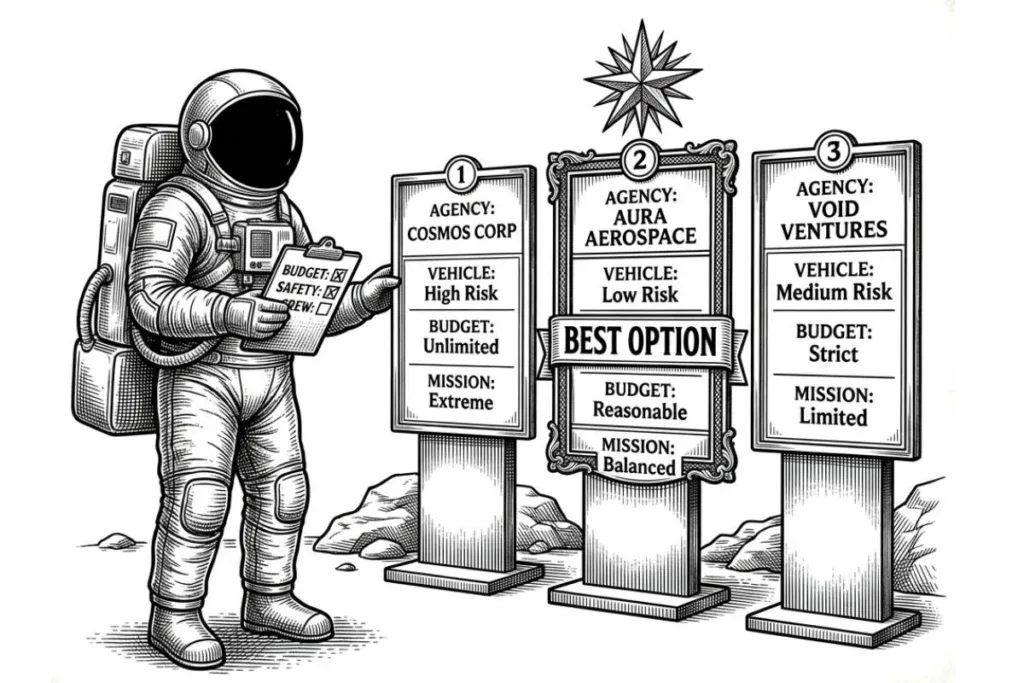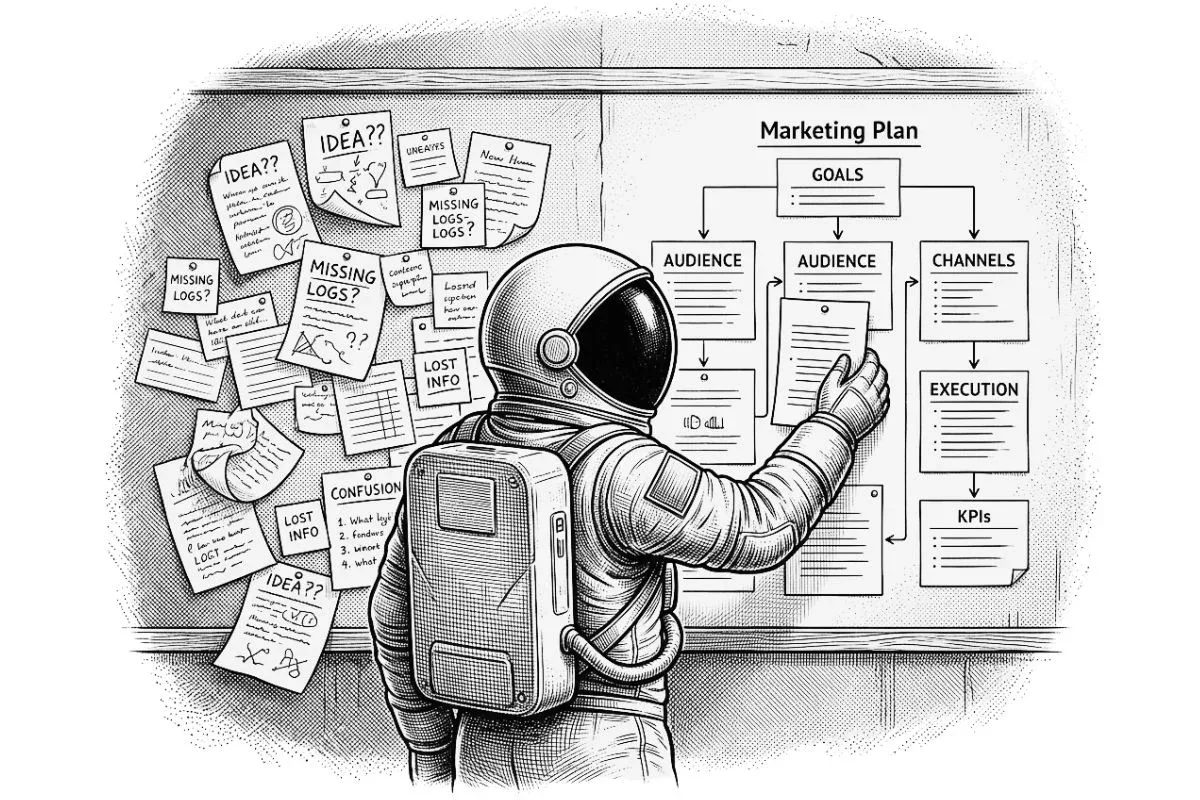
A marketing strategy is the plan that connects where your business is trying to go with how your marketing actually gets it there: who you’re after, why they should pick you, and what moves them from strangers to signed clients.
A lot of Central Arkansas businesses are posting, sending emails, running ads, and checking boxes. Far fewer have a real strategy connecting those efforts to revenue. There’s a real difference, and it shows up in the results. Random tactics, murky metrics, budgets that disappear without revenue to explain where they went: that’s what marketing without a strategy looks like. The good news is this isn’t a resources problem. It’s a clarity problem, and clarity is fixable. The team at iProv works with growth-minded businesses on exactly this kind of work, helping organizations move from scattered activity to a focused plan that drives results.
Jump to Section:
- What a marketing strategy actually is, and why most businesses are skipping it
- Why your business needs a marketing strategy, before spending another dollar on tactics
- How to build a marketing strategy that holds, a practical framework for ambitious organizations
- How to measure whether your strategy is working, the signals that separate growth from noise
- Common questions about marketing strategy answered in the FAQ section below
What Is a Marketing Strategy?
A marketing strategy is the plan that connects what you want your business to become with how you actually go about getting there. It answers the foundational questions first: who you’re selling to, what you need them to believe, and what has to be true in the market before any of that works. Everything else follows from that.
The ads, emails, content, and social posts come after that. Those are tactics. Useful ones, but still tactics. Tactics are the execution layer. Strategy is the thinking that makes execution mean something. If you want to go deeper on the difference between strategy and tactics, we break that down separately, but the short version is this: strategy decides where you’re going, tactics decide how you move.
A marketing plan is different too. Plans are operational: timelines, budgets, owners, deliverables. Strategy is the logic underneath the plan. You can have a very detailed plan built on a very weak strategy, and you’ll execute your way straight into stalled growth.
Most businesses skip the strategy layer because tactics feel like progress. You launch a campaign, run some ads, post content, and there’s immediate feedback. Something happened. Strategy doesn’t work that way. It asks you to sit with real uncertainty long enough to make actual decisions, and that’s a harder thing to do than clicking “publish.” Discomfort has a way of pushing people toward action over thinking, even when thinking is exactly what the situation calls for.
That pattern shows up in the data too. According to a 2025 Gartner survey, 84% of CMOs report high levels of strategic dysfunction within their marketing function. That’s not a small business problem or a budget problem. It’s an alignment problem, and it exists at every level.
Strategy as a system, not a document: that’s the frame we work from. A strategy that lives in a slide deck and never connects to daily decisions isn’t a strategy. It’s a formality. Which raises the real question: what does a working strategy actually do for your business?
Why Does Your Business Need a Marketing Strategy?
Most marketing budgets leak, not because of bad execution, but because there’s no strategy deciding where the money should go in the first place. You end up funding activity, not outcomes.
Most businesses that struggle with marketing aren’t struggling because of effort. They’re posting, running ads, sending emails, maybe dabbling in content. The work is happening. The results aren’t. That gap between effort and outcome is almost always a strategy problem, not an execution problem.
A 2024 McKinsey analysis found that only 27% of CMOs say they have a mature operating model capable of delivering on their growth responsibilities. So nearly three out of four marketing leaders are running without the system their ambitions actually require. The plans are there. The budgets are there. The teams are there. What’s missing is the connective tissue between what they’re doing day-to-day and the specific result they’re trying to produce.
Here’s where it gets interesting further down the funnel. Content Marketing Institute’s 2025 research puts only 22% of B2B marketers in the “extremely or very successful” camp, and it’s not because the other 78% aren’t publishing enough. What the top performers actually do differently is less glamorous than it sounds: their content has a job. There’s a traceable line from someone’s first click to a real conversion. For most companies, that connection was simply never wired into the strategy to begin with.
Put plainly: a to-do list tells you what to do. A strategy tells you why those specific actions, in that specific order, will move the needle for your particular business. Most companies are running on a list. They’re busy. They’re consistent. They’re just not building toward anything.
For businesses in Little Rock, Conway, Sherwood, and across Central Arkansas, that distinction carries more weight. A national brand running broad awareness campaigns can absorb wasted spend. Regional practices and service firms can’t. When your market is defined by geography and your competitors are three blocks away or across town, a tactic-first approach doesn’t just underperform. It burns budget that could have been targeted precisely at the people most likely to become patients, clients, or customers. Choosing the right growth strategy for your business isn’t a theoretical exercise here. It’s how you compete.
Growing businesses tend to share one habit: they make sharper calls earlier. Not bigger budgets. Clearer thinking. They know exactly who they’re after, they have a real answer for why that person should pick them, and they’ve mapped out the specific steps that move someone from “never heard of you” to a signed contract or a booked appointment.
That’s what a real marketing strategy does. It turns scattered effort into a growth system. The next section breaks down how to actually build one.
How Do You Build a Marketing Strategy?
Most teams start with tactics. They ask what to post, what to run, or what to fix first. The better question is where the business is trying to go and what marketing has to do with getting it there.
Why Does Generic Strategy Advice Keep Failing?
The standard advice produces the same output every time: a document with audience personas, a channel list, and quarterly goals. It gets reviewed in a kickoff meeting and then sits on a shared drive. The problem is not the framework itself. The problem is that the framework has no anchor to what the organization actually exists to do. Tactics get chosen before strategy is set. Strategy gets written before vision is clear. The result is activity without direction.

What Is iProv’s VSTA Framework?
iProv developed the VSTA framework to solve exactly this. VSTA gives a marketing strategy the order of operations it needs to produce momentum instead of just output. It stands for Vision, Strategy, Tactics, and Alignment, and the sequence is intentional.
- Vision: Where are you going and why? Before any channel gets chosen or any budget gets allocated, the business needs a clear statement of what success looks like in two to three years and what it would cost to miss it. Vision is the anchor. Without it, strategy drifts toward whatever is trending.
- Strategy: How will you reach the right people and move them to act? This is where audience targeting, positioning, channel selection, and budget allocation live. Strategy translates vision into a playbook. It answers the “how” before the “what.”
- Tactics: What specific actions, campaigns, and content will execute the strategy? SEO, paid search, content creation strategy, video, social: these are tactics. They belong here, in third position, not at the top of the planning process.
- Alignment: Are the right people informed, bought in, and moving in the same direction? This is the piece most organizations skip entirely. A marketing strategy without alignment produces effort. It does not produce a growth engine.
These four elements only work when they build on each other. If a team jumps straight to tactics, the rest gets shaky fast. The order matters. Strategy built on top of tactics produces chaos because the tactics were never chosen for the right reasons. Strategy built on top of vision produces a growth engine because every decision traces back to the same destination. Alignment is not a one-time meeting. It is an ongoing practice that keeps the system running.
How Can You Tell If You Have a Real Strategy or Just a Tactics List?
Try this before you build anything out. Can you describe where your business is trying to go in the next year or two, in plain language, without defaulting to a list of what you’re currently running? And if you pulled everyone responsible for executing that strategy into a room, would they walk out agreeing on what success looks like?
If either of those gets uncomfortable, you’re already at the right starting point. iProv’s VSTA framework page walks through exactly how to get there.
How Do You Know If Your Marketing Strategy Is Working?
You know your marketing strategy is working when the metrics you track connect directly to business outcomes, not just activity. Leads, booked calls, conversion rates, and revenue attributed to marketing tell you something. Impressions, followers, and likes tell you how busy you are.
The distinction matters more than most teams admit. Vanity metrics are easy to pull and easy to celebrate. Signal metrics require you to trace a result back to a decision. That tracing is where strategy lives.
A 2025 Gartner survey found that CMOs who plan 18 months or more out are 1.5 times more likely to report high marketing and business performance than those who do not. That number holds because long-term planning forces you to define what “working” actually means before you spend a dollar. Monthly activity reviews rarely do that.
Run these two questions at your next strategy review:
- Are the metrics we’re tracking tied to an actual business outcome, or are we just measuring what’s easy?
- What did we learn this quarter that’s going to change what we do next quarter?
If either one stalls the room, that’s exactly where the real work is. For teams that want outside help building those feedback loops, working with a marketing strategy consultant in Little Rock can move things forward faster than most expect.
Most teams working through this run into the same sticking points, and the next section covers the ones that come up most often.
You Ask, We Answer
What Is the Difference Between a Marketing Strategy and a Marketing Plan?
Think of it this way: a strategy is the decision about where you are going; a plan is the directions for getting there. Most businesses have no trouble writing the directions. Timelines, deliverables, owners, quarterly goals: all of that gets documented. What tends to be missing is the decision that should come first: what are you actually trying to build, and for whom?
That distinction matters most when something goes sideways. A plan tells you what to try next when a campaign underperforms. A strategy tells you whether that campaign made sense to begin with. Without the strategy, you are just optimizing the wrong thing.
How Long Does It Take to Build a Marketing Strategy?
Shorter than most people expect. The iProv VSTA process typically runs 4 to 6 hours. What makes it efficient is that the framework forces real decisions in the room rather than kicking them down the road. You leave with a documented strategy and a clear sense of what to stop doing. That last part, the stopping, is usually harder than people expect and often the most valuable outcome.
In-house efforts tend to drag. Teams have plenty of capability. The problem is that everyone inside the business has already accepted certain assumptions without realizing it. Nobody questions them anymore because nobody has had to. Bring in an outside voice and suddenly the obvious thing gets said out loud. That is usually what unsticks things.
What Makes a Marketing Strategy Fail?
Honestly? It depends, but alignment failure is the most common cause. The strategy gets written, reviewed, and approved, and then quietly ignored by the people actually executing it. Usually nobody means for that to happen. The problem is that the strategy was built without the right people in the room, so the team running campaigns operates on different assumptions than leadership. Nobody is working against each other. They are just working in different directions.
Tactics fail for different reasons: wrong audience, wrong timing, wrong message. But when a whole strategy fails, you can almost always trace it back to alignment. Or the absence of it.
Does a Small Business Need a Marketing Strategy?
Small businesses need one more than anyone. A $500,000 marketing budget can absorb waste. A budget of $3,000 or $5,000 a month cannot. Scattered spend at that level does not produce mediocre results. It produces nothing. You end up running three channels at half-effort and getting credit for none of them.
Little Rock, Conway, Sherwood, and across Central Arkansas: this is a local market. That means your competitors are not abstract. They are businesses your prospects already recognize. When someone does a search, they are picking from a short list, and they have probably already heard of most of the names on it. That reality changes what strategy looks like. It means you stop spreading budget across activity that looks busy on a report and start putting your full weight behind the two or three moves that actually show up where your buyers are making decisions.
From Activity to Momentum
Marketing strategy is not a document. It is the agreement between your vision, your execution, and the people responsible for both. Get that agreement right, and the tactics follow. Get it wrong, and even strong creative work tends to spin in place.
Busy teams are not the problem. If the work is not adding up to anything anyone can name, that is a strategy gap, and it shows up long before the results do.
iProv partners with organizations across Little Rock, Conway, and Central Arkansas to build marketing strategies through the VSTA framework, so the work your team is already doing starts pointing somewhere. When you are ready to move from activity to momentum, start the conversation here.