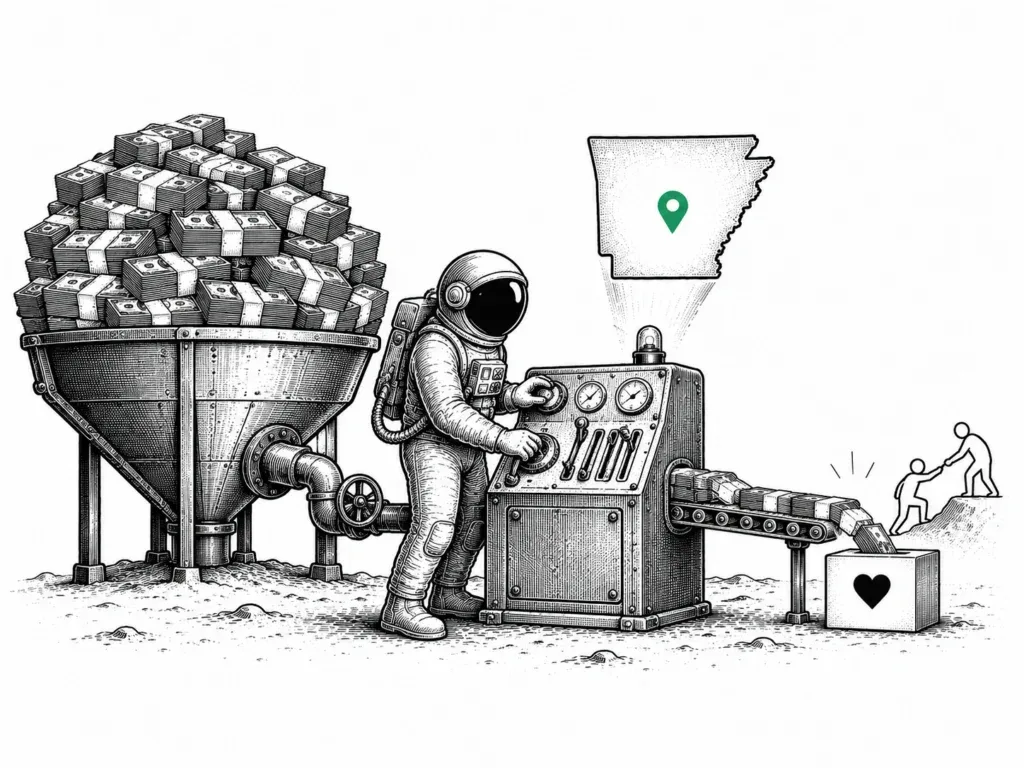
Digital marketing is every channel and tactic your business uses to reach potential customers online, working together as one connected system rather than a scattered set of tasks.
Choose your adventure: what do you actually want to know?
Most business owners have been pitched on digital marketing so many times the phrase has gone numb. Vendors use it. Articles use it. You probably use it yourself. But ask what it actually includes, and the answers get vague fast. That’s not on the business owner. The category has been buried under so much noise that the signal got lost along the way.
The honest version of this conversation starts local. A business on the Chenal Parkway corridor and a business in the Heights have completely different buyer profiles, different competitive environments, and different reasons someone would choose them over a national brand with a larger ad budget. What digital marketing means in practice, and why your current version of it might not be delivering, depends on understanding that gap before choosing a single channel.
What actually happens in most Central Arkansas businesses: someone sets up a Facebook page, someone else buys Google ads, and a third person posts to Instagram when they have a free hour. Each piece exists in isolation. None of them talks to the others. The result is spending without compounding, effort without direction. That’s the gap between having digital marketing and having a digital marketing strategy.
iProv works with growth-minded businesses across Central Arkansas to close that gap. Not selling tools or platforms, but building the connective tissue between them so every tactic earns its place.
What Does Digital Marketing Actually Include?
Search engines. Social media. Email. Paid ads. Video. These are the channels that make up digital marketing, and each one operates differently, attracts different audiences, and requires a different approach. Running them separately is where most businesses quietly bleed budget. They work when they’re built to feed each other.
Start with search engine optimization (SEO). This is the practice of making your website visible when people search for what you offer. Google’s own explanation of how search works makes it clear: search engines rank pages by relevance and credibility, not by who paid the most. A well-executed SEO strategy isn’t just about ranking. It creates a foundation every other channel builds on. The content your SEO produces gets shared on social media, drives email sign-ups, and gives paid ads something credible to point to.
Blog posts, guides, case studies, interview-based articles: all of it exists to answer the questions your customers are already asking somewhere. That’s content marketing. It gives your business something to actually say, across every channel, at every stage of the funnel. Skimp on it and you feel the gap everywhere: ads that click through to pages with nothing compelling on them, social accounts that run dry after a few weeks, email campaigns with no good material to point people toward.
Paid advertising, specifically pay-per-click (PPC) advertising, puts your business in front of people who are actively searching or browsing. Done well, it’s fast and measurable. Done in isolation, it gets expensive fast. The advertising methods that actually drive results share one trait: a clear path from click to conversion.
Social media rarely closes deals. But it’s where your audience decides whether they like you before they ever reach out. In the gap between someone first seeing your business and actually contacting you, social is doing quiet, steady work, building enough trust (or eroding it) to tip the decision.
Email marketing is consistently underestimated. It’s direct, owned (no algorithm between you and your audience), and it outperforms most other channels when used to nurture rather than blast.
Video is no longer a nice-to-have. In most categories, buyers expect it. Short clips on social build familiarity. A YouTube explainer answers the question they searched for at 11 pm. A simple customer testimonial closes the gap between interest and trust. It doesn’t need to be polished. It needs to be real.
Local and geo-targeted advertising flips the script on the “spray and pray” approach. Instead of broadcasting to everyone, you’re reaching the specific communities where your customers actually live. For a business in Central Arkansas, that matters. Location-based advertising works precisely because the audience is concentrated, the competition is real but beatable, and the right targeting can put you in front of people who are genuinely ready to buy.
Here’s what integrated actually looks like: a blog post earns a search ranking, gets picked up and shared on social, goes out to an email list, and pulls traffic into a landing page while a paid retargeting campaign runs quietly in the background. Every channel feeds the others. That’s not a theory. That’s a functioning digital marketing strategy.
What Do Central Arkansas Businesses Actually Need to Know?
Central Arkansas is not the digital Wild West it was ten years ago. Businesses in Little Rock, Conway, North Little Rock, Sherwood, Benton, and Bryant are running paid search, investing in SEO, and competing for the same keywords your business needs. The entry point is lower than most owners expect, but so is the margin for a half-hearted effort.
Local SEO is where the gap shows up most clearly. When someone searches “dentist near me” or “marketing agency Little Rock,” whether your business appears in that result is effectively a business decision. Not appearing is one too. The search result is the new storefront, and for most local service categories, it determines who gets the call.
The Central Arkansas market sits in an interesting position. Competitive enough that digital presence matters, but focused enough that a smart strategy can move faster than it would in a major metro. You don’t need an outsized budget. A dental practice in West Little Rock is not competing against the same businesses as a contractor in Bryant. A business in Hillcrest is not reaching the same buyer as one in Chenal. National brands can run ads here, but they cannot account for those distinctions. That local specificity is a real competitive edge, and it belongs to you.
The businesses winning local search in Central Arkansas aren’t spending more than their competitors. They’re making sharper decisions. Fewer channels, cleaner message, better follow-through. According to 2025 IAB data reported by Marketing Dive, digital video ad spend alone grew 14% in 2025, a signal that digital investment is accelerating, not stabilizing. Local businesses that treat digital as optional are ceding ground to competitors who don’t.
Finding the right digital marketing partner matters more in a focused regional market than it might in a major metro, where volume can mask strategic drift. We work with businesses across Central Arkansas building growth systems grounded in local market realities and tied to measurable outcomes. If you’re evaluating options, our guide on finding the right digital marketing partner walks through what to look for and what to avoid.
How Is Digital Marketing Different From Traditional Marketing?
Digital marketing is marketing that happens online, where every action can be tracked, measured, and adjusted. Traditional marketing (TV, radio, print, billboards) reaches audiences through physical or broadcast channels where results are estimated, not measured.
That distinction shapes every decision you make, from how you plan the campaign to what success looks like when it’s over.
What Does “Measurability” Actually Mean in Practice?
When a prospect clicks your Google ad, spends four minutes on your landing page, and submits a contact form, you have a record of all of it. The ad they clicked, the page they landed on, how long they stayed. Radio can tell you 80,000 people were in range of your spot on a Tuesday morning. What it cannot tell you is whether any of them turned down the volume.
That’s not a knock on traditional channels. Broadcast still builds brand awareness at scale, and some businesses genuinely benefit from a mix of both. The honest difference is that digital gives you a feedback loop and traditional largely doesn’t.
Can You Actually Reach a More Specific Audience?
Yes, and the difference in precision is significant. A search ad only appears when someone types the exact phrase you’re targeting. Social campaigns can go further. You could reach homeowners in a specific zip code who’ve already been browsing home improvement content. Traditional media doesn’t offer that kind of control. It broadcasts to whoever’s watching or listening, and you’re hoping enough of them fit your profile.
When budgets are tight, precision becomes everything. A small business can compete on digital channels not by outspending anyone, but by spending smarter on a tightly defined audience. A billboard just has to be the biggest sign on the busiest road. Same cost whether it works or not.
How Fast Can You Actually Adjust?
A print ad locked into a magazine issue for six weeks is what it is. A digital campaign can be paused, rewritten, and relaunched in hours. If a headline isn’t driving clicks, you test a new one. If a landing page is converting poorly, you change the layout. Most small and mid-sized businesses can test something on Monday, see what happened by Wednesday, and change course before the week is out.
Is Digital Marketing Actually a Two-Way Conversation?
In a way, yes. Email campaigns let subscribers reply. Social posts generate comments, questions, and shares. Reviews and direct messages give businesses a channel to hear from real customers in real time. Traditional advertising broadcasts a message and goes silent.
More interaction means more to manage. Businesses that handle it well build something traditional advertising rarely creates: a relationship.
Why Do So Many Businesses Get Digital Marketing Wrong?
Most businesses that struggle with digital marketing are not failing because they lack effort. They’re failing because they started doing before they finished thinking. Strategy gets skipped, or never happens at all, and tactics fill the vacuum.
Tactics before strategy. A business opens a Facebook page, starts posting three times a week, and wonders why it isn’t generating leads. The problem is not the posting frequency. No one decided who the page is for, what action those people should take, or how Facebook fits into the broader way the business finds customers. A channel without a purpose is noise.
Channel accumulation. “We’re on Facebook, Instagram, LinkedIn, TikTok, and we just launched a podcast.” That sounds active. It usually means a business has spread itself thin across platforms with no system connecting any of them. One channel executed well almost always outperforms five channels executed poorly.
Vanity metrics. Follower counts, impressions, and likes are easy to track and genuinely satisfying to watch grow. They are, in most cases, not the point. The question that matters is whether digital activity is generating calls, bookings, form submissions, or sales. Impressive dashboards and empty waiting rooms are a real combination, and it happens more often than most people want to admit.
Vendor mismatch. There’s a meaningful difference between someone who executes tasks and someone who asks about your mission first. Hiring a social media manager to post content is not the same as hiring a strategist to figure out whether social media is even the right channel for your goals. Execution without strategy is activity, not marketing.
Inconsistent effort. Digital channels reward consistency. A business that runs hard for six weeks, disappears for three months, then relaunches with a new approach is essentially starting over each time. Algorithms deprioritize dormant accounts. Audiences disengage. The compound effect that makes digital marketing valuable over time never has a chance to build.
Understanding the strategy vs. tactics distinction is the starting point for avoiding most of these patterns. The businesses that get digital marketing right are not necessarily the ones with the biggest budgets. They’re the ones that knew what they were trying to accomplish before they chose how to accomplish it.

What Does a Real Digital Marketing Strategy Look Like?
A real digital marketing strategy starts with three things: who you’re trying to reach, what you want them to do, and how you’ll measure success. Everything else, platforms, content, ad spend, follows from those answers.
Most businesses skip that part entirely. They jump straight to posting on Instagram or running Google ads because it feels like forward motion. It isn’t. A channel without a clear direction is just noise with a budget attached.
What Should Come Before You Choose a Platform?
Before you touch a single channel, three questions need honest answers.
Who are you actually trying to reach? Not a broad demographic on a slide deck. A real person with a real problem, one you know how to solve.
What action do you want them to take? Call, book, fill out a form, walk in. One clear next step.
How will you know if it’s working? Not whether your follower count went up. Whether the phone rang.
Once those answers are locked in, channel selection gets simple. You go where your audience already is, with a message built around the action you want them to take.
How Does a Content Engine Actually Work?
A content engine is the opposite of a content calendar. A calendar asks “what do we post this week?” An engine asks “how does this one piece of content do five jobs?”
Write a blog post targeting a keyword your customers are actively searching. That post becomes a short video. The video gets clipped into social posts. Those posts point back to the blog, which has a lead magnet that captures email addresses. The email list nurtures subscribers toward a booked call. One piece of strategic content, moving across multiple touchpoints. That’s what building a content strategy looks like when it’s built to generate demand, not fill a feed.
Some businesses rank consistently, generate leads, and close new clients while others post constantly and wonder why nothing converts. That gap isn’t about effort or how much they spend.
What Does This Actually Look Like for a Local Business?
A professional services firm in Central Arkansas came to us after two years of consistent ad spend with no clear picture of which channel was driving their clients. They were running paid search, social, and email simultaneously. Their monthly reports showed impressions and clicks, not revenue. Within 30 days of connecting Pathfinder, iProv’s first-party attribution platform, the data showed two campaigns were generating the majority of their inbound calls. Three others were spending budget on an audience that was finding them through referrals anyway. They reallocated. Ad spend dropped by a third. Lead volume held.
One has a growth system. The other is guessing.
Does Your Team Actually Know What the Strategy Is?
Strategy only works when everyone’s reading from the same playbook.
When the front desk doesn’t know what’s running on Google ads, leads fall through the cracks. When sales is pitching one message and marketing is running another, customers feel the friction even if they can’t name it.
The VSTA framework, iProv’s proprietary approach connecting Vision, Strategy, Tactics, and Alignment, was built to solve this specific problem. It’s the operational foundation that keeps channels, teams, and goals pointed in the same direction before you spend a dollar. Not a branding exercise. The connective structure that makes everything else work.
What Metrics Actually Matter?
Clicks don’t pay rent. Phone calls do.
Impressions and follower counts tell you something, but they don’t pay the bills. The numbers that actually move your business are leads generated, calls booked, forms submitted, and revenue you can trace back to a specific channel or campaign. That’s why tracking a local lead generation funnel from first touch all the way through conversion matters so much. Once you know where your leads are coming from and what they do after they land, you can put more money behind what’s working and cut what isn’t.
What Does Digital Marketing Cost, and What Should It Deliver?
Digital marketing costs vary a lot depending on your channels, your market, and what you’re actually trying to accomplish. But cost is the wrong question. What it returns is the right one.
A PPC campaign in a competitive local market like healthcare or home services looks nothing like a content marketing program for a niche B2B (business-to-business) firm. Channel matters. Market maturity matters. So does how well the strategy fits the business. A $2,000/month spend that consistently generates $20,000 in revenue is a fundamentally different conversation than a $500/month spend with no measurable outcome.
Industry guidance generally suggests allocating 7 to 10 percent of revenue to marketing for established businesses. For most industries, digital channels now represent the majority of that mix. What you actually allocate should reflect your growth goals, your competitive environment, and where your customers are paying attention.
How Do You Know If a Marketing Partner Is Worth It?
The structure of the relationship tells you a lot before results do.
Watch for red flags: flat monthly retainers with no reporting, deliverables that are hard to pin down, KPIs (key performance indicators) that have nothing to do with revenue, and partners who can’t explain in plain terms what they’re measuring or why it matters.
What you want instead is someone who ties every activity to a business outcome, brings you data you didn’t ask for, and occasionally says “you don’t need that channel yet.” That restraint is a signal of competence. We’ve told clients to cut channels. We’ve recommended they spend less with us when the data didn’t support continuing. A good marketing partner acts more like a growth advisor than a vendor moving line items.
Reporting should answer one question above all: is this working? If your monthly report doesn’t answer that, the relationship probably needs a reset.
Questions About Digital Marketing We Hear in Little Rock
How Long Does It Take for Digital Marketing to Work?
Paid search can put you in front of customers the same day your campaign goes live. SEO is a different animal. You’re typically looking at three to six months before rankings start moving in any meaningful way, and building a content library that reliably generates leads? Budget closer to a year for that.
The blog post that earns a top ranking in month four is still pulling in traffic in month fourteen, with no cost-per-click attached to any of it. Paid ads stop the moment the budget does. The strongest approach usually runs both at once: paid search covering near-term lead flow while organic search builds underneath it. Figuring out which one your business needs to lean on right now is exactly the kind of conversation we start with.
Do I Need to Be on Every Platform?
No. Being on every platform is one of the fastest ways to spread your team thin and produce mediocre content everywhere instead of strong content somewhere.
For most businesses in Central Arkansas, a well-maintained Google Business Profile, one focused social channel, and a clean website will outperform a scattered presence across six platforms where posting is inconsistent. Let your audience tell you where to show up, not the other way around.
What’s the Difference Between SEO and Paid Advertising?
Organic search isn’t something you buy your way into. You earn it through content quality, site speed and structure, and whether other credible sites think your pages are worth linking to. That takes time. But when you rank, the traffic keeps coming with no cost-per-click attached.
Paid advertising through Google Ads or social media puts your business in front of people immediately, but you pay for every visit. The moment spending stops, so does the traffic. SEO builds your long-term foundation; paid advertising accelerates short-term results. Most growth-oriented businesses use both, adjusting the balance based on budget, seasonality, and goals.
How Do I Know If My Digital Marketing Is Actually Working?
It depends on what you’re trying to do. A law firm running a call campaign should be measuring call volume and which channel drove each one. A service business lives and dies by leads per ad dollar. The mistake most businesses make is watching website sessions tick up and calling that progress. Sessions are a leading indicator, not an outcome.
That gap between channel and outcome is exactly what Pathfinder was built to close. It’s iProv’s first-party attribution platform. It traces a lead from the first touchpoint all the way through to a phone call or form submission without relying on third-party cookies. When a client asks us which channel is driving their customers, we don’t guess. We show them. If your current marketing partner can’t answer that question clearly, the measurement infrastructure probably needs work before the campaigns do.
Can a Small Business in Little Rock Compete With Bigger Companies Online?
Yes. Local search is actually one of the clearest examples of where a focused smaller business beats a national brand. A national chain with a generic web presence often loses in local results to a local competitor with strong reviews, a well-optimized Google Business Profile, and content that speaks directly to the Central Arkansas market. Google’s local algorithm rewards relevance and proximity, not just budget.
A Tuesday evening post lands differently for a Hillcrest audience than a Bryant one. National brands cannot know that. You can. Let those advantages slip and the edge slips with them.
What Should I Look for When Hiring a Digital Marketing Partner?
Start with clarity. A good partner can explain what they’re doing, why they’re doing it, and what you should expect to see, without hiding behind jargon. We put together a guide to hiring the right digital marketing partner that walks through the questions worth asking before you sign anything.
Communication matters, but it’s not enough on its own. You want a partner who’s thinking strategically, not just running tasks. Ask them how they define success, what they do when something underperforms, and whether their past clients ran businesses with real buying cycles and real stakes. Then ask for references and case studies. The answers will tell you a lot.
Stop Collecting Channels. Build a System That Grows.
Digital marketing done well is not a collection of tactics you check off a list. It is a connected system where each part reinforces the others. Your content builds search visibility. Your search visibility drives traffic. Your traffic generates leads that inform your content. When those pieces are aligned and talking to each other, the system compounds over time. When they are not, you end up investing in channels that feel busy but do not move the business forward.
Ambitious organizations get specific about what they’re building before they start spending. In our experience working with clients across Central Arkansas, the programs that produce results have a few things in common: they stay focused on a tight set of channels, they trust what the data says even when it’s inconvenient, and they’re willing to change course when something isn’t moving. That discipline is harder than it sounds. It’s also the difference between a marketing budget that compounds over time and one that just keeps getting spent.
iProv works with growth-minded businesses in Little Rock and across Central Arkansas to build marketing programs with that kind of coherence. We do the strategy work first, then the execution, because the order matters. Campaigns built without a strategic foundation generate activity without direction.
If you are ready to stop guessing and start building, let’s talk.